
West Palm Beach Quality Septic: What to Expect at a Septic Pumping Visit in West Palm Beach
What happens from the moment the truck arrives to the moment it leaves, and what to ask for before it does.
Having a stranger dig in your yard and open a tank of sewage is not something most people do often enough to know what to expect. This guide walks through a routine septic pumping appointment from start to finish, so you know what a thorough visit looks like and what to ask for along the way.
Before the appointment
A few things make the visit faster and cheaper:
- Find the lids if you can. If you know where the tank is, mark it. If the lids are buried, the crew will have to locate and uncover them, which typically adds $150 to $350. If nobody has any idea where the tank is, mention it when you book.
- Clear the way. The truck needs to get reasonably close, and the hose needs a clear path from the truck to the tank. Move vehicles, open gates and secure dogs.
- Know your tank size if you can. It sets the price. Florida sizes tanks by bedrooms and floor area; a home of one to three bedrooms up to 2,250 square feet usually has at least 900 gallons.
- Hold back heavy water use for a few hours before the visit if the system has been sluggish.
When the crew arrives
The crew will ask where the tank is, whether there have been any problems, and when it was last pumped. It helps to mention any alarm, smell, slow drains or wet ground you have noticed. On a system with a pump chamber, tell them where the control box is.
Finding and opening the tank
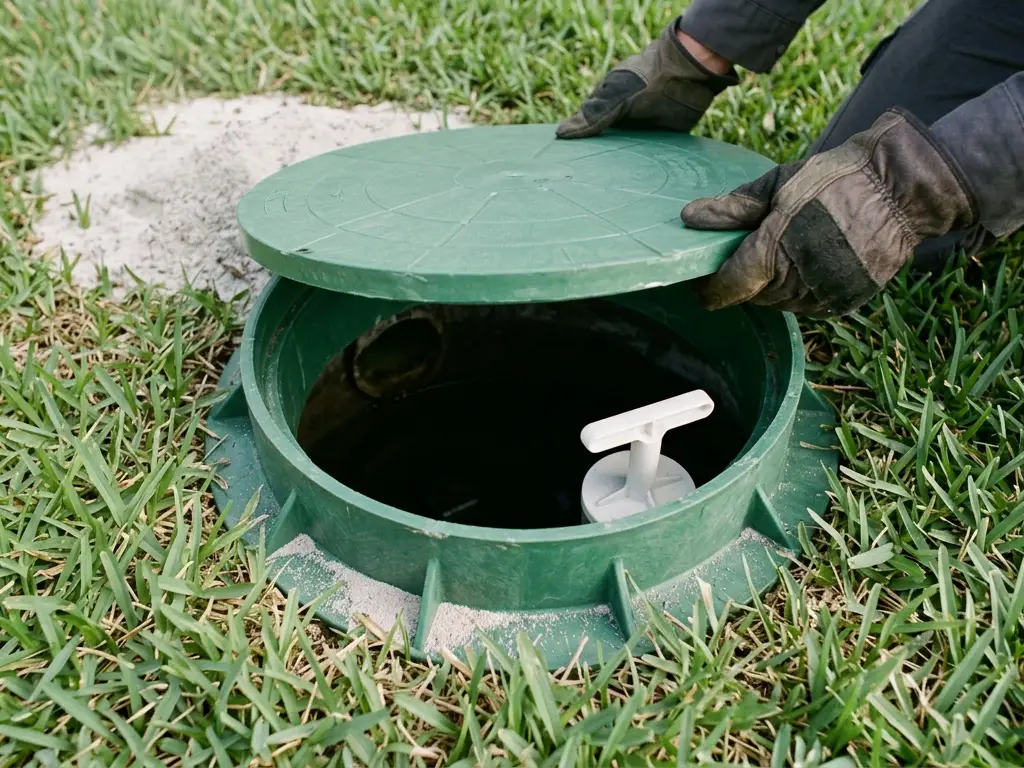
If the lids are at grade, this takes a minute. If they are buried, the crew probes the ground to find the tank top, then digs down to the lids. In the sandy soil common around West Palm Beach this is usually quick, though in the wet season the hole can fill with groundwater. Most tanks have two openings, one over the inlet side and one over the outlet side, and both should be opened.
The part most people miss: looking before pumping
Before the hose goes in, a careful crew looks at the liquid level in the tank. If it sits above the outlet pipe, water is not leaving the tank as fast as it should, which is often the first sign that the drainfield is struggling. They should also note the thickness of the scum layer on top. Ask what they saw; it is free information that is impossible to get once the tank is empty.
That first look is worth asking for: a high water line spotted at a $325 to $625 pump-out can flag a drainfield problem while it is still a $1,500 to $6,500 repair.
Pumping
The vacuum hose goes in through the opening and the crew draws out the liquid, the floating scum and the settled sludge. They will often break up compacted sludge on the bottom so it can be removed. A standard residential tank usually takes well under an hour to pump once it is open.
Checking the parts that matter
With the tank empty, the crew can see what cannot be seen at any other time:
- The baffles, which keep solids and grease in the tank. A missing or broken outlet baffle lets grease reach the drainfield.
- The effluent filter, if there is one. It gets cleaned by hosing it off over the tank so the debris goes back inside.
- The tank itself: cracks, corrosion, roots, or signs that groundwater is getting in.
- The pump and floats, on a pumped system, if you ask.
If the system has a pump chamber
Many systems around West Palm Beach have a second tank holding a pump that lifts effluent to a raised drainfield. It collects the solids that slip past the first tank over the years, so it usually gets pumped too, and it is priced accordingly. While it is open, a thorough crew checks that the floats move freely, that the pump starts when the level rises, and that the alarm sounds when the high-water float lifts. Ask them to test the alarm while you are there, so you know what it sounds like and where the control box is. If the panel shows corrosion or the floats are coated in grease, that is the time to hear about it, not during a backup.
Closing up
The lids go back on securely. If they were buried, the crew backfills and replaces the sod. This is the moment to consider risers, which bring the lids up to grade so the next visit starts with lifting a lid rather than digging.
Paperwork to ask for
Before the truck leaves, ask for a written record that includes:
- The date and the volume pumped
- The tank size and number of compartments
- The liquid level before pumping and the condition of the baffles
- Whether an effluent filter was present and cleaned
- Anything the crew recommends watching
The hauler must hold a state septage permit and take the load to an approved facility. The receipt is worth keeping, and a buyer will ask for your service history if you ever sell.
After the visit
You can use the house normally straight away. The tank refills with wastewater over the following days and weeks, and the bacteria that break down waste re-establish on their own. There is no need to buy an additive to restart it.
How much it costs
A standard pump-out on a tank up to 1,000 gallons typically runs $325 to $625 around West Palm Beach, and a larger tank $450 to $850. The septic tank pumping page covers what moves the price. Homes in older neighborhoods such as those around Lake Worth Beach sometimes have tanks under patios or driveways built later, which adds time; knowing that in advance keeps the quote accurate.
Safety
Never open or lean into a septic tank yourself. The gases inside can overcome a person in seconds, and every year people die entering septic tanks. Keep children and pets away from an open tank, and make sure the lids are secure when the crew leaves.
Questions about your own system? Talk it through on the phone.
Call (561) 658-4115Questions about septic pumping visit
How long does a septic pumping appointment take?
Often an hour or so for a tank with accessible lids. Add time if the lids are buried and have to be located and uncovered, or if the tank has gone many years without service.
Do I need to be home when my septic tank is pumped?
Not always, if the crew can reach the tank. It helps to be there the first time, to see the tank opened and hear what was found.
What should I ask for after a septic pump-out?
A written record with the date, volume pumped, tank size, the liquid level before pumping, the condition of the baffles, and whether an effluent filter was cleaned.
Do I need a septic additive after pumping?
No. The bacteria re-establish on their own from ordinary household wastewater within days.
Need the work done rather than explained?
Septic Tank Pumping in West Palm Beach and Lake Worth Beach, with a written price before anyone starts.
More septic guides
The Best Septic Companies in West Palm Beach
Local septic companies serving West Palm Beach, ranked by documented trading history, with no paid placements.
Septic Tank Pumping Costs in Palm Beach County
The typical price ranges for septic work around West Palm Beach, and the factors that push a quote up or down.
Palm Beach County Septic Tank Requirements
Who permits septic work in Palm Beach County, what the state rules require, and the deadlines that come with a sewer notice.
Signs You Need Septic Pumping in West Palm Beach
How to read what your septic system is telling you, from a slow drain to a pump alarm, before it becomes a backup.