
West Palm Beach Quality Septic: Septic Tank Pumping Costs in Palm Beach County
The typical price ranges for septic work around West Palm Beach, and the factors that push a quote up or down.
Most septic companies will not publish a price, which is why homeowners call three of them and still cannot tell whether the number they were given is fair. This guide sets out what septic work typically costs around West Palm Beach and across Palm Beach County, what makes a quote go up, and which of those factors you can do something about.
Every figure here is a range, and every range matches the prices published on this site's service pages. Septic pricing genuinely varies with tank size, depth, access, the water table and the condition of the system, and a company quoting a flat number without seeing the property is either guessing or planning to revise it.
Septic tank pumping
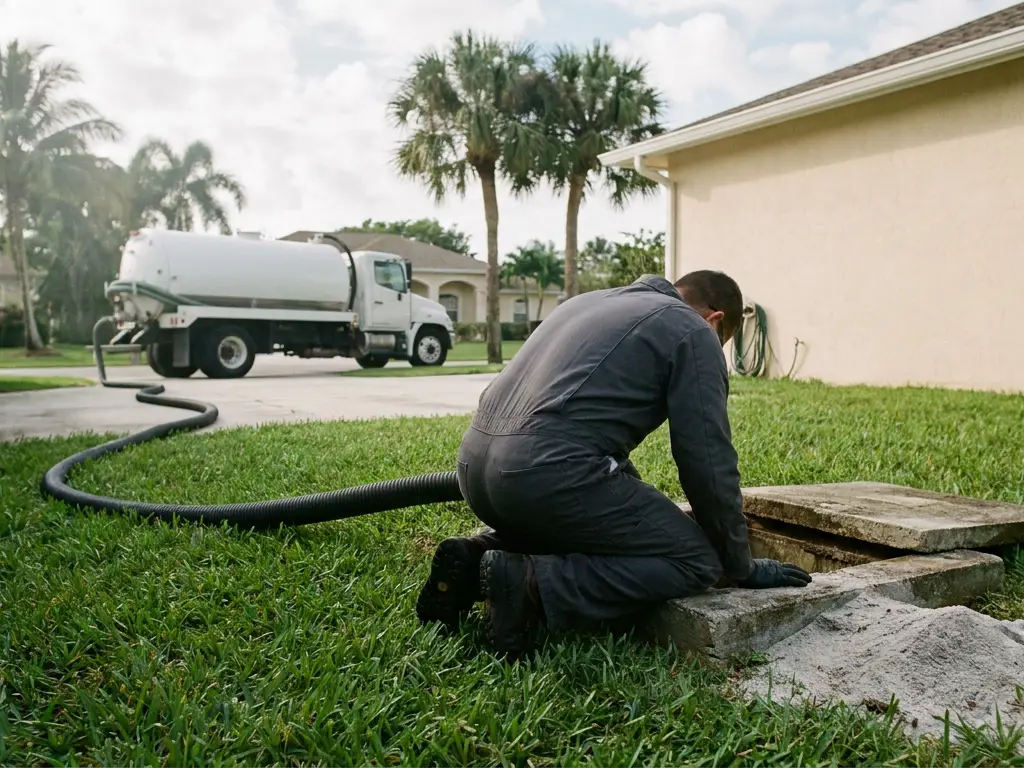
A standard residential pump-out on a tank up to 1,000 gallons typically runs $325 to $625 in this area. That covers arriving, opening an accessible lid, pumping out the sludge, scum and liquid, and hauling the septage to an approved facility.
Three things move it immediately:
- Tank size. A larger tank, 1,050 to 1,500 gallons, typically runs $450 to $850. Florida sizes tanks by bedrooms and floor area, so a four-bedroom home usually has at least 1,050 gallons to pump.
- A buried lid. If nobody knows where the lid is or it sits a foot under the lawn, finding and uncovering it adds $150 to $350. A tank nobody can find at all typically costs $150 to $450 to locate.
- Time since the last service. A tank that has gone ten years may need its compacted sludge broken up and the walls washed down, which takes longer than a routine pump-out.
The math that matters: skip a $325 to $625 pump-out until solids reach the drainfield and the repair runs $1,500 to $6,500 at best, or $12,000 to $25,000 if the field has to be rebuilt as a mound.
Inspections
- Routine inspection, tank opened and components checked: $250 to $450
- Full inspection with pump-out and drainfield evaluation: $450 to $900
The gap between the two is mostly the pump-out and the drainfield work. For a home purchase, the full inspection is the one worth paying for, because the drainfield is the part that costs five figures.
Component repairs
These are the cheap end of septic repair, and most of them exist to protect the drainfield:
- Effluent filter replacement: $150 to $350
- Inlet or outlet baffle replacement: $300 to $800
- Pipe, lid and inlet line repairs: $300 to $2,500
- Riser and lid brought to grade, per opening: $350 to $900
Pumps, floats and alarms
A lot of systems in this county have a pump that lifts effluent up to a raised drainfield. When the alarm on the control box sounds, the repair is usually one of these:
- Float switch or alarm repair: $200 to $650
- Pump control panel replacement: $600 to $1,600
- Lift pump replacement: $900 to $2,500
Aerobic treatment units add an annual maintenance contract, typically $300 to $600 a year, and an aerator or air pump replacement at $400 to $1,200 when it fails.
Drainfields, tanks and new systems
This is where the water table decides the price. Florida requires the bottom of a new drainfield to sit at least 24 inches above the wet season high water table, and in the flatwoods soils across much of the county that seasonal water table can rise to within a foot or so of the surface. Where there is room to dig a field in, the price stays at the lower bands; where there is not, the field is built up with imported sand and the price moves up.
- Drainfield repair, lines, distribution box or partial rebuild: $1,500 to $6,500
- Drainfield replacement, in-ground: $6,000 to $15,000
- Mound or fill drainfield: $12,000 to $25,000
- Septic tank replacement: $4,000 to $9,000
- New system, three bedroom, in-ground drainfield: $9,000 to $18,000
- New system with a mound drainfield: $15,000 to $30,000
On the larger western lots, such as parts of Wellington and The Acreage, there is often room for a new field, but it has to clear a private well by 75 feet, and the flat, low ground often means a raised field.
Converting to sewer
When a sewer line reaches the street, the septic side of the conversion is the permitted abandonment of the old tank: an abandonment permit, a pump-out by a permitted hauler, breaking the tank open, and filling it with sand. That typically runs $800 to $2,500. The utility's connection charges and the plumber's line to the street are separate, and they can be the larger part of the bill.
What you can do to keep the price down
- Know where your lids are, or better, have risers fitted during your next pump-out so nobody has to dig again.
- Keep records. A dated note of each pump-out and what was found saves diagnostic time on every future visit.
- Pump in the dry season. Crews can see the system more clearly, and scheduled work avoids the storm backlog.
- Fix small things early. A clogged filter or a broken baffle costs a few hundred dollars. The drainfield it protects costs thousands.
What a septic quote often leaves out
Ask about these before you compare two numbers, because they are where a low quote and a high one usually differ:
- The permit. Repairs, replacements and new systems need one through the Florida Department of Health in Palm Beach County, and the permit fee is either in the quote or it is not.
- Fill and restoration. A raised field needs imported sand, and any dig needs the lawn put back. Ask whether sod is included.
- Electrical work. A new pump chamber needs a circuit and a control panel, which may involve an electrician.
- Locating the tank. If nobody knows where it is, finding it is billed separately.
- Disposal. The hauler's disposal charge is usually built into a pump-out price, but not always.
Why nobody should quote a drainfield by phone
A pump-out can be priced sight unseen within a range. A drainfield cannot. Its price depends on soil borings, the estimated seasonal water table, setbacks to wells and water, and whether a pump is needed, none of which can be known from a phone call. Treat any firm drainfield figure given without a site evaluation as a guess.
Questions about your own system? Talk it through on the phone.
Call (561) 658-4115Questions about septic tank pumping cost
How much does it cost to pump a septic tank in Palm Beach County?
A standard residential pump-out on a tank up to 1,000 gallons typically runs $325 to $625. Larger tanks run $450 to $850, and finding and uncovering a buried lid adds $150 to $350.
How much does a drainfield replacement cost in West Palm Beach?
An in-ground replacement typically runs $6,000 to $15,000. Where the water table requires a raised field, a mound or fill drainfield typically runs $12,000 to $25,000.
Why do septic prices vary so much?
Tank size, how deep and how accessible the lid is, how long since the last service, and above all the water table, which decides whether a drainfield can go in the ground or has to be raised.
Is a septic inspection worth the cost?
For a home purchase, yes. A full inspection with pumping and a drainfield evaluation typically runs $450 to $900, against a drainfield that can cost $6,000 to $15,000 or more to replace.
Need the work done rather than explained?
Septic Tank Pumping in West Palm Beach and Wellington, with a written price before anyone starts.
More septic guides
The Best Septic Companies in West Palm Beach
Local septic companies serving West Palm Beach, ranked by documented trading history, with no paid placements.
Palm Beach County Septic Tank Requirements
Who permits septic work in Palm Beach County, what the state rules require, and the deadlines that come with a sewer notice.
Signs You Need Septic Pumping in West Palm Beach
How to read what your septic system is telling you, from a slow drain to a pump alarm, before it becomes a backup.
Septic vs Sewer in West Palm Beach
A surprising number of owners are not sure whether their house is on septic or sewer. Here is how to find out, and why it matters.