
West Palm Beach Quality Septic: Palm Beach County Septic Tank Requirements
Who permits septic work in Palm Beach County, what the state rules require, and the deadlines that come with a sewer notice.
Septic rules in Palm Beach County are Florida's rules, applied locally. They decide whether a new system can be built on a lot, what a repair has to achieve, how close a drainfield can sit to a well, and how long an owner has to connect once sewer arrives. This guide sets out what the rules actually say, with the rule numbers, so you can check any of it yourself.
It is general information, not legal advice, and rules change. The permitting office has the final word on any specific property.
Who writes the rules and who enforces them here
Florida's onsite sewage program moved from the Department of Health to the Department of Environmental Protection on July 1, 2021, under the law known as the Clean Waterways Act. The rules now sit in Chapter 62-6 of the Florida Administrative Code, and the governing statute is section 381.0065 of the Florida Statutes.
The transfer changed who owns the rules more than who does the work. DEP took over permitting directly only in the Panhandle counties and Marion County. In Palm Beach County, the permitting and inspections are still carried out by the Florida Department of Health in Palm Beach County, through its Environmental Public Health office, which reviews plans for septic systems and private wells before building permits are issued. Septic contractors in Florida register with the Department of Health.
When you need a permit
State law requires a permit to construct, repair, modify, abandon or operate a septic system. In practice:
- Routine pumping does not need a permit, but the company doing it must hold a state septage permit and take the waste to an approved facility.
- Repairs to the system, including drainfield repairs, need a repair permit, which is valid for 90 days. Repairs are inspected by the department or by a master septic tank contractor.
- New systems need a construction permit, valid for 18 months with one possible 90-day extension, an inspection before the system is covered, and final approval before the building can be occupied.
- Alterations to the building that increase sewage flow or change the conditions a system was permitted under, such as adding bedrooms, need approval, and the tank must be pumped and visually inspected as part of it, unless the system was approved within the previous five years and has no record of failure.
- Aerobic treatment units need an operating permit and a contract with an approved maintenance entity, and the health department inspects properties with them at least once a year.
A homeowner may work on the system of their own owner-occupied single-family home without being a registered contractor, but every permitting requirement still applies.
The 24-inch rule behind most local costs
The single most important number in Palm Beach County septic work is 24. Rule 62-6.006 requires the bottom of a new drainfield to sit at least 24 inches above the wet season high water table, which is estimated from the soil's color and texture rather than from where the water happens to be on the day of the test.
Repairs have their own floor. Where an existing field sits less than 24 inches above that water table, the repair must keep the existing separation or at least 12 inches, whichever is greater. If the field bottom is already less than 12 inches above it, the repair has to bring the drainfield up to full new-system standards.
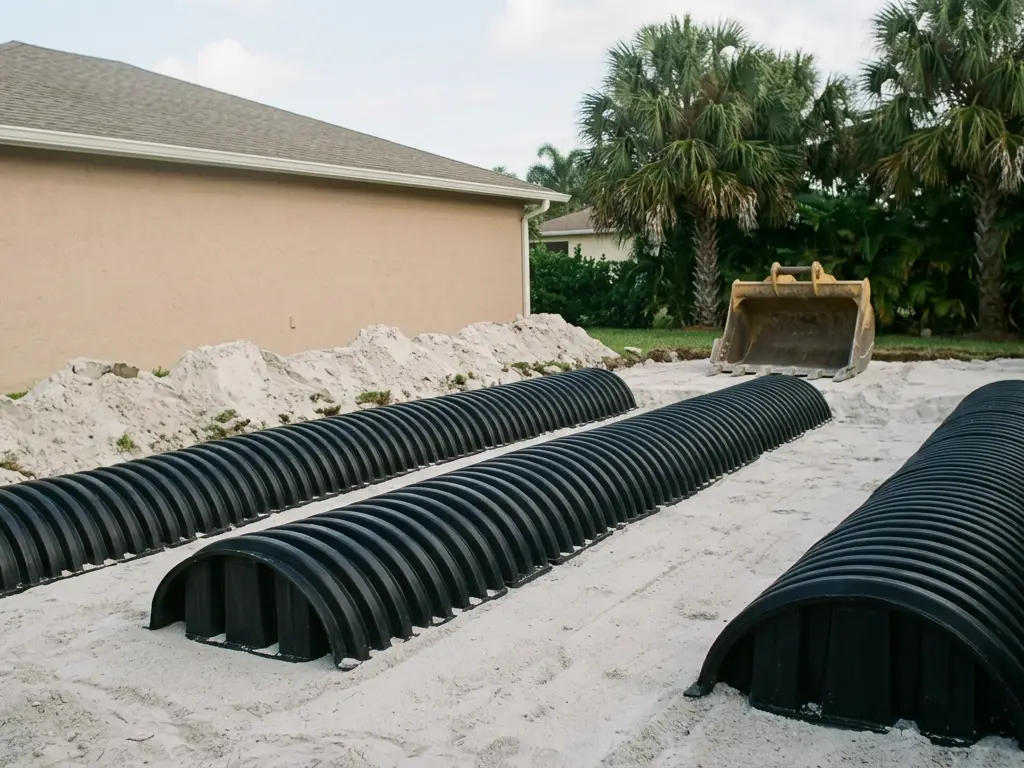
Across much of the county, that rule meets flatwoods soils where a cemented organic layer about a meter down holds water up, and the wet season water table can sit within half a foot to a foot and a half of the surface. That is why so many local systems are built up as mounds, with a pump to lift effluent to them, and why a raised field is the usual answer when an old one fails.
The rule is why the numbers diverge so sharply here: a $325 to $625 pump-out on schedule versus a $12,000 to $25,000 raised field when a neglected one fails.
Setbacks and tank sizes
For systems permitted under the current rule, 62-6.005 requires a drainfield to sit at least 75 feet from a private drinking water well and 75 feet laterally from surface water bodies. On a lot with its own well, such as most of the rural lots west of the city, that distance often decides where the field goes.
Tank size follows the house. Under 62-6.008, a home of one to three bedrooms up to 2,250 square feet needs at least a 900 gallon tank, and a four-bedroom home up to 3,300 square feet needs at least 1,050 gallons. Where the bedrooms and the floor area point to different sizes, the larger one applies.
Nitrogen-reducing systems
A conventional drainfield removes only part of the nitrogen in household wastewater, roughly 30 to 40 percent where the field sits at least 24 inches above groundwater. Florida now requires enhanced nutrient-reducing systems in certain places: for new systems on lots of one acre or less inside a basin management action plan area where sewer is not available, and for new systems in the Indian River Lagoon area. Whether a particular lot falls inside one of those areas is a mapping question answered at permit review, and it is worth asking early, because these systems cost more. The septic installation page covers what a new system involves.
When sewer arrives
Florida Statute 381.00655 sets the deadlines:
- The utility must notify owners at least a year before a sewer line becomes available.
- Once the line is available and the owner has written notice, a working septic system must connect within 365 days.
- A system that needs repair must connect within 90 days of written notice.
- In hardship cases, an extension of up to 90 days can be approved.
After connecting, rule 62-6.011 requires the old system to be abandoned within 90 days: an abandonment permit, a pump-out by a permitted septage hauler with a receipt, the tank bottom broken open or the tank collapsed, the tank filled with clean sand and covered with soil, and an inspection by the department or the local utility or plumbing authority.
Several conversion programs are active around the county. The Loxahatchee River District's neighborhood conversion program lists Jupiter Farms and Palm Beach Country Estates for future sewer, with the dates still to be determined. Wellington's water supply plan describes bringing septic neighborhoods onto the village system by majority opt-in. The Town of Lake Clarke Shores is converting its Northern Utility Service Area now.
After a storm
Florida health officials advise against pumping a septic tank while the ground is flooded, because a tank pumped dry under an exceptionally high water table can be crushed, and pumping does nothing about the groundwater itself. The advice is to use as little water as possible and to have the system checked and repaired once the water recedes.
Is a septic inspection required when you sell?
Florida does not impose a general statewide requirement to inspect an ordinary residential septic system at sale. Buyers commonly ask for one anyway, and some lenders do. The state does require the tank to be pumped and inspected when an alteration increases flow, as described above.
Where to find records for a property
The Environmental Public Health office of the Florida Department of Health in Palm Beach County holds septic permit records. Older permits vary in detail, but many include a sketch of where the tank and drainfield were placed, which is the cheapest way to find a buried tank.
Questions about your own system? Talk it through on the phone.
Call (561) 658-4115Questions about septic tank requirements
Who regulates septic systems in Palm Beach County?
The rules are Florida's Chapter 62-6, owned by the Department of Environmental Protection since July 1, 2021. In Palm Beach County, permits and inspections are carried out by the Florida Department of Health in Palm Beach County.
How far must a septic drainfield be from a well in Florida?
At least 75 feet from a private drinking water well for systems permitted under the current rule, and 75 feet laterally from surface water bodies.
How high above the water table does a drainfield have to be in Florida?
At least 24 inches above the wet season high water table for a new system. Repairs must keep the existing separation or at least 12 inches, whichever is greater.
How long do I have to connect to sewer in Palm Beach County?
Under Florida Statute 381.00655, 365 days from written notice that sewer is available, or 90 days if your septic system needs repair. The old tank must then be abandoned within 90 days of connecting.
Do I need a permit to pump my septic tank?
No. Routine pumping does not need a permit, but the company doing it must hold a state septage permit and dispose of the waste at an approved facility.
Need the work done rather than explained?
Septic System Installation in West Palm Beach and Jupiter Farms, with a written price before anyone starts.
More septic guides
The Best Septic Companies in West Palm Beach
Local septic companies serving West Palm Beach, ranked by documented trading history, with no paid placements.
Septic Tank Pumping Costs in Palm Beach County
The typical price ranges for septic work around West Palm Beach, and the factors that push a quote up or down.
Signs You Need Septic Pumping in West Palm Beach
How to read what your septic system is telling you, from a slow drain to a pump alarm, before it becomes a backup.
Septic vs Sewer in West Palm Beach
A surprising number of owners are not sure whether their house is on septic or sewer. Here is how to find out, and why it matters.