
West Palm Beach Quality Septic: Signs You Need Septic Pumping in West Palm Beach
How to read what your septic system is telling you, from a slow drain to a pump alarm, before it becomes a backup.
A septic system rarely fails without warning. The trouble is that its warnings are easy to explain away: a slow drain gets blamed on hair, a smell on the neighbor's yard, a wet patch on the sprinklers. This guide sorts the common signs into three groups, because they point to different problems with very different price tags: a tank that is simply full, a drainfield that is struggling, and a pump that has stopped.
First: how long has it been?
Before any symptom, the calendar. Most households need their tank pumped every three to five years; the Loxahatchee River District, which handles sewer in the Jupiter area, advises checking the sludge depth every year and pumping every two to five. If nobody knows when the tank was last pumped, or it has been more than five years, it is due regardless of symptoms. A tank can be close to full and still drain normally right up to the day it does not.
Signs the tank is full
These usually clear up after a pump-out, which is the cheap outcome.
- Drains slowing across the whole house at the same time. One slow sink is a plumbing clog. Every drain slowing together points to the system.
- Gurgling from a toilet or tub when the washing machine empties. Air is being pushed back through the plumbing because the water has nowhere to go.
- A sewage smell near the tank lid. A tank close to full vents odor more readily, especially on still, humid days.
- An effluent filter that keeps clogging. A filter that needs cleaning again within months usually means the tank is overdue.
Signs the drainfield is struggling
These are the expensive group, and they are worth acting on early, because a drainfield caught while it can still be repaired costs a fraction of one that has to be replaced.
- Soggy ground or standing water over the drainfield on a dry day. Effluent is coming up instead of going down.
- Grass over the field greener and faster growing than the rest of the lawn. The field is feeding it more than it should.
- Drains still slow shortly after a pump-out. If emptying the tank did not help, the problem is downstream of it.
- Water sitting in the drainfield inspection ports. If your system has ports, water standing in them is a direct reading of a saturated field.
Catch these early and a $1,500 to $6,500 drainfield repair is often still possible; wait until the field has clogged through and it becomes a $6,000 to $15,000 replacement.
Signs the pump has stopped
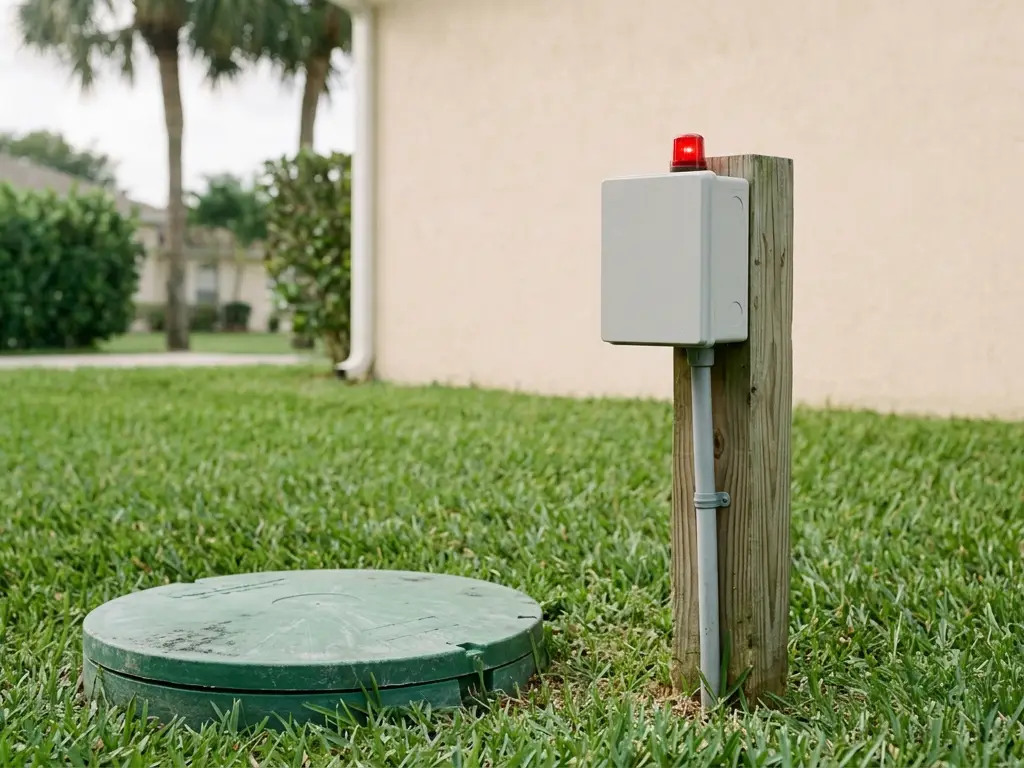
Many systems around West Palm Beach have a pump that lifts effluent up to a raised drainfield, with a control box on a post near the tank. If yours does:
- The alarm is sounding or the red light is on. The pump chamber is filling faster than it is being emptied.
- The pump runs and runs without stopping. Usually a stuck float or a failed check valve.
- The raised field has gone dry while the house is backing up. The field is not being dosed.
An alarm is not a nuisance to be silenced and forgotten. The chamber has a limited reserve above the alarm level, and once it is used up the system backs up toward the house. Cut water use, check the breaker once, and call.
The South Florida pattern: trouble after rain
A system that only struggles after heavy rain, and recovers a few days later, deserves its own category here. About 70 percent of South Florida's rain falls between mid-May and mid-October, and the water table rises with it, in places to within half a foot to a foot and a half of the surface. A drainfield built close to the required 24 inches of separation has almost nothing left when that happens.
Rain-only problems usually mean the field is losing a fight with groundwater rather than failing outright, or that water is getting into a cracked tank or a leaky riser. Either way, the dry season gives a truer reading, and that is the best time to have it looked at.
When to stop reading and call
Some signs are not diagnostic puzzles; they are emergencies:
- Sewage coming up into a shower, tub or floor drain
- Effluent surfacing in the yard where children or pets play
- A pump alarm that will not clear
- A sinking or soft patch over the tank, which can mean a failing lid
In any of those cases, stop running water and get it seen. The septic backup page covers the first ten minutes in detail.
Why this matters more on some lots than others
On the large lots west of the city, a failing system sits on the same property as a private well. Around Royal Palm Beach, the village itself is largely on the county utility, but the large-lot areas beyond it run on wells and septic, on flatwoods ground where the water table rises close to the surface every wet season. The signs above are the same everywhere; the stakes are higher where the well shares the lot with the field.
What a service visit will check
A crew responding to any of these signs should look before it pumps: the liquid level in the tank before pumping starts, the condition of the baffles and the filter, the pump and floats if there are any, and the ground over the field. Ask for what they found in writing. That note is the best evidence you will have if the problem comes back.
Questions about your own system? Talk it through on the phone.
Call (561) 658-4115Questions about septic warning signs
How do I know if my septic tank is full?
The common signs are drains slowing across the whole house, gurgling when the washer empties, a sewage smell near the tank, and an effluent filter that clogs quickly. If it has been more than three to five years since the last pump-out, assume it is due.
What are the signs of a failing drainfield?
Soggy ground or standing water over the field in dry weather, grass over the field greener than the rest of the lawn, drains that stay slow after a pump-out, and water standing in the field inspection ports.
What does it mean when my septic alarm goes off?
The pump chamber is filling faster than the pump is emptying it, usually because of a failed pump, a stuck float, a tripped breaker, or groundwater entering after heavy rain. Cut water use and have it checked.
Why does my septic system only have problems after it rains?
Because the water table rises into the soil the drainfield needs to be dry, or groundwater is leaking into the tank. In South Florida about 70 percent of the year's rain falls between mid-May and mid-October.
Need the work done rather than explained?
Septic Backup and Overflow in West Palm Beach and Royal Palm Beach, with a written price before anyone starts.
More septic guides
The Best Septic Companies in West Palm Beach
Local septic companies serving West Palm Beach, ranked by documented trading history, with no paid placements.
Septic Tank Pumping Costs in Palm Beach County
The typical price ranges for septic work around West Palm Beach, and the factors that push a quote up or down.
Palm Beach County Septic Tank Requirements
Who permits septic work in Palm Beach County, what the state rules require, and the deadlines that come with a sewer notice.
Septic vs Sewer in West Palm Beach
A surprising number of owners are not sure whether their house is on septic or sewer. Here is how to find out, and why it matters.