
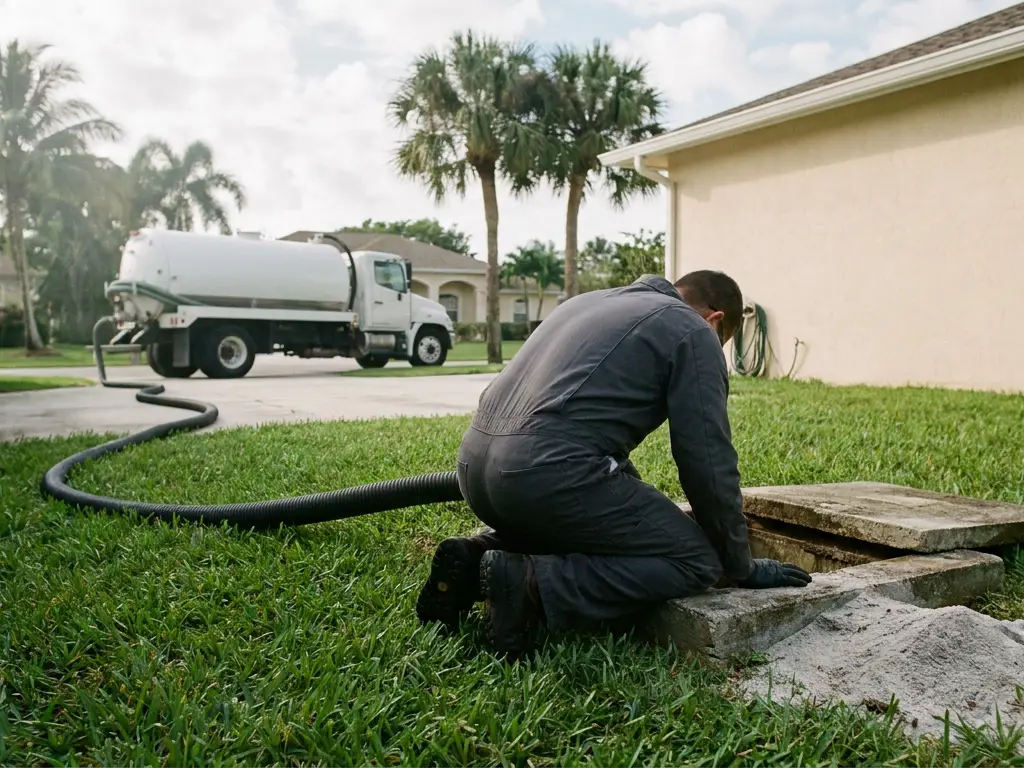
West Palm Beach Quality Septic: Septic Tank Pumping in West Palm Beach, FL
Pump-outs and full tank cleaning for homes and businesses within 20 miles of downtown West Palm Beach.
- Within 20 miles of downtown West Palm Beach
- Written price before work starts
- We work with licensed, insured local contractors
- Phones answered 7am to 7pm, seven days
West Palm Beach Quality Septic arranges septic tank pumping for properties in and around West Palm Beach, from the large lots of The Acreage to the older streets near the coast. A pump-out removes the two layers that build up in every tank: the sludge that settles to the floor and the scum of grease and soap that floats on top. What is left behind is the clarified liquid the drainfield is designed to take. Most households need it every three to five years, and the only reliable way to know where a tank sits in that cycle is to open the lid and measure.
Let the sludge reach the outlet and a $325 to $625 pump-out turns into a $1,500 to $6,500 drainfield repair at best.
Why the pump-out protects the drainfield, not the tank
A septic tank is a settling chamber: solids sink, fats float, and the middle layer flows out to the drainfield. That works until the sludge climbs high enough that there is no quiet water left for solids to settle in. From then on, solids ride out with the effluent and lodge in the drainfield, which cannot digest them.
Nothing reverses that damage from inside the tank; pumping afterward only stops more solids arriving. That is why a routine pump-out is the cheapest maintenance item on the whole system: it protects the one component that costs five figures to replace.
Pumping versus cleaning, and when each is the right call
A pump-out draws off the liquid, the scum and the loose sludge through a vacuum hose. A cleaning goes further: compacted sludge is broken up and the walls and baffles are washed down.
On a tank serviced every few years, pumping is enough. On a tank nobody has opened in a decade, cleaning is worth the extra time, because a straight pump-out can leave a hard layer behind.
- Pump-out: a tank that is on schedule
- Cleaning: a tank that has gone eight years or more, or has no known history
What a crew checks while the tank is open
An empty tank is the only time anyone can see the baffles, the concrete and the line on the wall showing how high the liquid was running. A liquid level above the outlet before pumping starts is the clearest early warning that the drainfield is not accepting water. Ask the crew what they saw and write it down with the date.
Describe what the system is doing and get a straight read on what it usually means in West Palm Beach.
Call (561) 658-4115Signs a tank is due or overdue for pumping
- More than three years since the last pump-out, or nobody knows
- Drains throughout the house slowing at the same time
- Gurgling from a toilet or tub when the washer drains
- A sewage smell near the tank lid
What septic tank pumping costs in West Palm Beach
The main drivers are tank size, how deep the lid sits, how far the truck has to reach, and how long it has been since the last service. Typical local ranges:
Standard residential pump-out, tank up to 1,000 gallons: $325 to $625
Larger tank, 1,050 to 1,500 gallons: $450 to $850
Finding and uncovering a buried lid, added to a visit: $150 to $350
Effluent filter replacement: $150 to $350
Typical ranges in the West Palm Beach area, not quotes. Call (561) 658-4115 and the price for your property is put in writing before anyone starts.
Pumping in Palm Beach County conditions
Permits, haulers and what the county requires
A routine pump-out does not need a permit in Florida. The company doing it does: septage is regulated waste, and the hauler has to hold a state septage permit and take the load to an approved facility. If the house is being altered in a way that changes the system, such as adding bedrooms, the state rule (62-6.001 of the Florida Administrative Code) requires the tank to be pumped and visually inspected as part of that approval, unless the system was approved within the previous five years and has no record of failure.
Timing a pump-out around the water table
South Florida gets about 70 percent of its rain between mid-May and mid-October, and groundwater rises with it. Pumping a tank dry while the surrounding ground is saturated carries real risk: Florida health officials warn that a tank emptied under an exceptionally high water table can be crushed. For scheduled work, the dry months from November through May are the better window. For a tank that is backing up, the crew weighs the risk on site.
Where pumping schedules slip the most
In The Acreage almost every home runs on its own well and septic tank, often on a large lot where the tank is out of sight and easy to forget. Nearer the coast, the tanks that get missed are on properties the sewer lines skipped, where a new owner can assume the house is on sewer until the first backup.
If the tank is overflowing today
Stop running water, including the dishwasher and the washing machine, and keep children and pets away from anything surfacing in the yard. If the ground is flooded after a storm, the safer move can be to wait for the water to drop before pumping. Call and describe what you are seeing; that decides it.
Septic Tank Pumping: questions people ask
How often should a septic tank be pumped in West Palm Beach?
Every three to five years for most households, sooner for a large family on a small tank. The Loxahatchee River District advises checking the sludge depth every year and pumping every two to five years.
How much does septic tank pumping cost in West Palm Beach, FL?
A standard pump-out on a tank up to 1,000 gallons typically runs $325 to $625. Larger tanks run $450 to $850, and finding and uncovering a buried lid adds $150 to $350. Final price depends on tank size, depth and access, and it is confirmed in writing before work starts.
Is septic pumping the same as septic cleaning?
Not quite. Pumping removes the liquid and loose sludge through a hose. Cleaning also breaks up compacted sludge and washes down the walls and baffles. On a tank that is serviced on schedule, pumping is enough; on one that has been ignored for years, cleaning is worth it.
Will pumping fix a drainfield that is already failing?
No. Pumping stops more solids from reaching the field and buys time, but it cannot reopen soil that is already clogged. If effluent is surfacing or the field stays wet in dry weather, the drainfield needs its own evaluation.
Should I pump my septic tank after a hurricane?
Not while the ground is flooded. Florida health officials advise against pumping a tank while the water table is exceptionally high, because a tank emptied in saturated ground can be crushed, and pumping does nothing about the groundwater itself. Use as little water as possible and have the system checked once the water recedes.
Often needed alongside septic tank pumping
Septic Inspection
Routine and full septic inspections that tell you what condition the system is in before it tells you itself.
Drainfield Repair
Wet ground, slow drains and a field that stays soggy in dry weather, diagnosed before anyone quotes a replacement.
Septic Riser Installation
Risers that bring buried septic lids up to grade, so every future service starts with lifting a lid instead of digging.
The Acreage and Loxahatchee
Well-and-septic country west of Royal Palm Beach, where nearly every home runs its own system.
Not sure which of these you need? Call (561) 658-4115 and describe what you are seeing. Every service and the full service area are listed too.