
West Palm Beach Quality Septic: Septic Service in West Palm Beach, FL
Pumping, inspections, repairs, drainfields and new systems within 20 miles of downtown West Palm Beach, with a written price before anyone starts.
- Within 20 miles of downtown West Palm Beach
- Written price before work starts
- We work with licensed, insured local contractors
- Pumping, repairs, drainfields and installs
- Phones answered 7am to 7pm, seven days
West Palm Beach Quality Septic connects homeowners and property managers in West Palm Beach, and in the communities within 20 miles of downtown, with septic crews that pump tanks, inspect systems, repair pumps and lines, and rebuild drainfields. Inside the city limits much of the city is on the public utility. The septic work in this market sits mostly around it: in the unincorporated neighborhoods beside the city, and in the large-lot communities to the west, where almost every home runs on a private well and its own tank.
The tank is the part of a septic system you can service cheaply; the drainfield is the part you cannot. Florida requires the bottom of a drainfield to sit at least 24 inches above the wet season high water table, and in the flatwoods soils across much of this county that water table can rise to within six to eighteen inches of the surface for months. That shapes what almost every repair here costs.
Put off a $325 to $625 pump-out until solids reach the drainfield, and the fix becomes a $6,000 to $15,000 drainfield, or $12,000 to $25,000 if the lot needs a mound.
What septic work around West Palm Beach actually involves
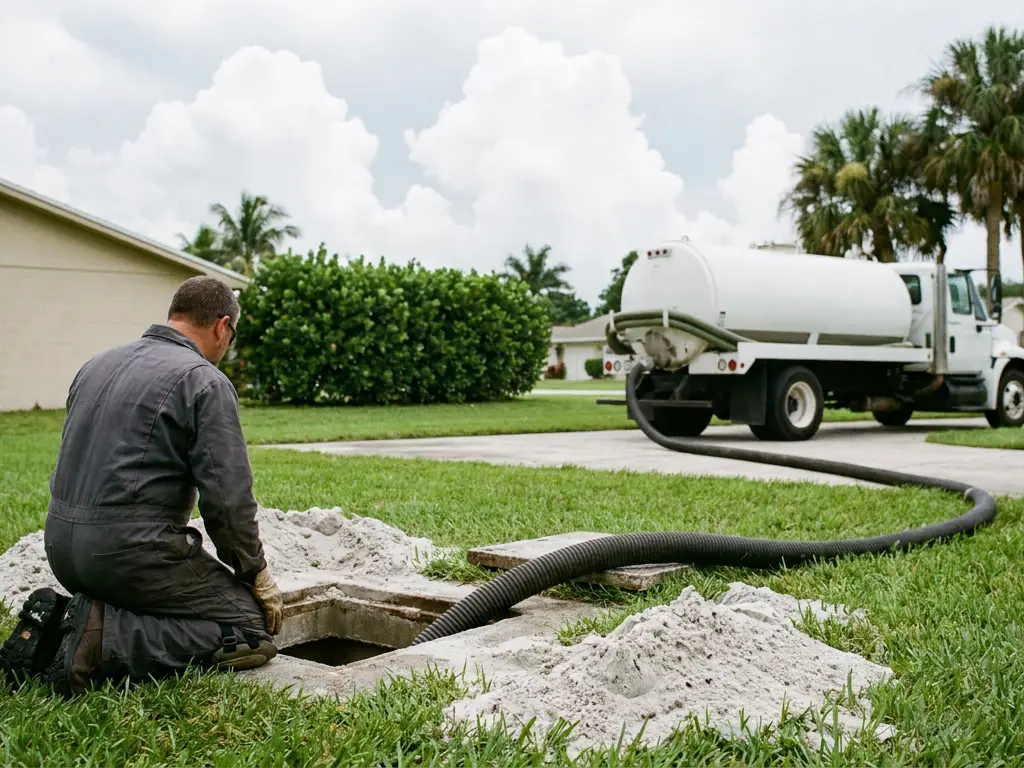
Most calls start with a tank that needs pumping or a drain that has slowed down. A pump-out every three to five years removes the sludge and scum, and it is the one moment anyone gets to look inside at the baffles, the effluent filter and the water line. Where the water table sits high, the drainfield is often raised as a mound and fed by a pump with a float switch and an alarm, so pump and alarm calls are routine local work.
The rest follows the life of a property: an inspection when a house sells, risers so a buried lid never has to be dug up again, a new tank or drainfield when an old system gives out, and the permitted abandonment of a tank when a street gets sewer. Every service is listed, with what it typically costs, on the septic services page.
Describe what the system is doing and get a straight read on what it usually means.
Call (561) 658-4115Signs a septic system near West Palm Beach needs attention
Septic systems fail slowly, then all at once. These are the usual early signs, roughly in the order they appear.
- Drains slowing across the whole house at once, not just one sink
- Gurgling from a tub or toilet when the washing machine empties
- A sewage smell near the tank lid or over the drainfield
- An alarm sounding, or a red light on the control box beside the tank
- Soggy ground or standing water over the drainfield on a dry day
- Grass over the field greener and faster growing than the rest of the lawn
- Toilets that back up after heavy rain and recover a few days later
The last one is the South Florida pattern: a system losing its fight with the water table rather than failing outright. Having it checked in the dry months, when the ground gives an honest reading, saves money either way.
What septic service costs around West Palm Beach
Typical local ranges. Tank size, depth, access and the water table all move the number, and nobody can honestly quote a drainfield without seeing the ground.
Standard residential pump-out, tank up to 1,000 gallons: $325 to $625
Full inspection with pump-out and drainfield evaluation: $450 to $900
Lift pump replacement: $900 to $2,500
Drainfield repair: lines, distribution box, partial rebuild: $1,500 to $6,500
Drainfield replacement, in-ground: $6,000 to $15,000
Mound or fill drainfield: $12,000 to $25,000
Typical ranges in the West Palm Beach area, not quotes. Call (561) 658-4115 and the price for your property is put in writing before anyone starts.
Septic rules and ground conditions in Palm Beach County
Who permits the work
Florida's septic rules live in Chapter 62-6 of the Florida Administrative Code, owned by the Department of Environmental Protection since July 1, 2021. In Palm Beach County the permits and inspections are still handled by the Florida Department of Health in Palm Beach County. A permit is required to construct, repair, modify or abandon a system; routine pumping needs none, but the hauler must hold a state septage permit.
The ground under a drainfield here
Much of the land between the coastal ridge and the Everglades is pine flatwoods, on sandy soils such as Myakka, the Florida state soil. A cemented organic layer about a meter down holds water above it, and in the wet season the water table can sit within half a foot to a foot and a half of the surface for about four months. That is why the 24-inch rule so often means building a field up rather than digging one in.
Where the tanks are
The heaviest concentration is to the west. The Acreage is not served by public water or sewer, and almost every home there has its own well and septic system. Jupiter Farms to the north is on the Loxahatchee River District's list for future septic to sewer conversion, with no date set. Beyond those two, septic turns up in the rural pockets near Palm Beach Gardens and Wellington, where some neighborhoods still run on wells and tanks, and on individual properties across the county that the sewer lines never reached. The service area page covers each community and the ground it sits on.
If the house is backing up right now
Stop running water, and keep children and pets away from anything surfacing outside, because it is untreated sewage. If the yard is flooded after a storm, hold off on pumping until the water goes down: Florida health officials warn that a tank pumped dry under a water table that high can be crushed. Otherwise, call.
Septic questions from West Palm Beach homeowners
How often should a septic tank be pumped in Palm Beach County?
Every three to five years for most households, sooner for a large family, a small tank or a garbage disposal. The Loxahatchee River District, which runs sewer for the Jupiter area, advises checking the sludge depth every year and pumping every two to five years.
How much does septic tank pumping cost in West Palm Beach?
A standard residential pump-out on a tank up to 1,000 gallons typically runs $325 to $625. Larger tanks run $450 to $850, and finding and uncovering a buried lid adds $150 to $350. Those are typical local ranges; the price for your property is confirmed in writing before work starts.
Who regulates septic systems in Palm Beach County?
The rules are the state's: Chapter 62-6 of the Florida Administrative Code, owned by the Department of Environmental Protection since July 1, 2021. Permitting and inspections in Palm Beach County are still carried out by the Florida Department of Health in Palm Beach County, through its Environmental Public Health office.
Why do septic problems get worse in the rainy season here?
South Florida gets about 70 percent of its rain between mid-May and mid-October, and the water table rises with it. When groundwater climbs into the soil beneath a drainfield, the field has nowhere to send water, so drains slow until the dry season returns.
Do I have to connect to sewer if a line is built past my house?
Usually yes. Florida Statute 381.00655 requires a working septic system to connect within 365 days of written notice that sewer is available, and within 90 days if the system needs repair. Once connected, the old tank has to be abandoned under permit within 90 days: pumped, broken open and filled with clean sand.
Where the work happens
The service area is everything within 20 miles of downtown West Palm Beach: north through Riviera Beach, Palm Beach Gardens and Jupiter to Jupiter Farms, west through Royal Palm Beach and Wellington to The Acreage and Loxahatchee Groves, and south through Lake Worth Beach, Greenacres and Lantana to Boynton Beach. If you are not sure whether an address is inside it, call (561) 658-4115.