
West Palm Beach Quality Septic: Septic vs Sewer in West Palm Beach
A surprising number of owners are not sure whether their house is on septic or sewer. Here is how to find out, and why it matters.
In a county where one street is on public sewer and the next is on septic tanks, plenty of homeowners are not sure which they have. It usually comes to light at a bad moment: a backup, a home sale, or a letter announcing that sewer is coming. This guide explains how to tell, how the two differ in cost and responsibility, and what Florida requires when a sewer line reaches your street.
How the two systems differ
A sewer connection sends everything that leaves the house down a private line to a public main in the street, and from there to a treatment plant run by a utility. The owner pays a monthly sewer charge and is responsible for the private line up to the property boundary or the connection point; the utility handles the rest.
A septic system treats wastewater on the property. Everything flows into a buried tank, where solids settle and grease floats, and the clarified liquid flows out to a drainfield, where the soil finishes the treatment. There is no monthly bill, but the owner is responsible for all of it: pumping the tank every few years, keeping the drainfield working, and paying for repairs when either fails.
How to tell which one you have
- Look at the utility bill. A sewer or wastewater charge means you are connected. A water bill with no sewer line on it, or no water bill at all because the house has a well, points to septic.
- Look for lids in the yard. Round green or black plastic lids, or a concrete slab, somewhere between the house and the back of the lot usually mean a septic tank. A control box with a light on a post near them means a pumped system.
- Ask the county. The Florida Department of Health in Palm Beach County keeps septic permit records. If a permit exists for the address, there is or was a septic system.
- Ask the neighbors. Houses on the same street usually share the same answer, though not always.
- Do not rely on a cleanout. A capped pipe in the yard exists on both kinds of system and proves nothing on its own.
If you are buying, ask the seller directly and get it in writing. A full septic inspection during the contract period answers it for certain.
What each one costs you
On sewer, the cost is steady and predictable: a monthly charge, plus the rare repair on the private line. On septic, there is no monthly charge, but the costs arrive in lumps. A standard pump-out typically runs $325 to $625 every three to five years. A drainfield repair typically runs $1,500 to $6,500, and a replacement $6,000 to $15,000, or $12,000 to $25,000 where the water table requires a raised field.
That is the real comparison: a septic system that gets a $325 to $625 pump-out on schedule is cheap to own; one that does not can cost $6,000 to $15,000 in a single afternoon.
What happens when sewer arrives
Florida sets the timeline in Statute 381.00655. The utility must give owners at least a year's notice before a line becomes available. Once it is available and you have written notice, a working septic system must connect within 365 days. If your system needs repair, the deadline is 90 days from written notice. In hardship cases, an extension of up to 90 days can be approved.
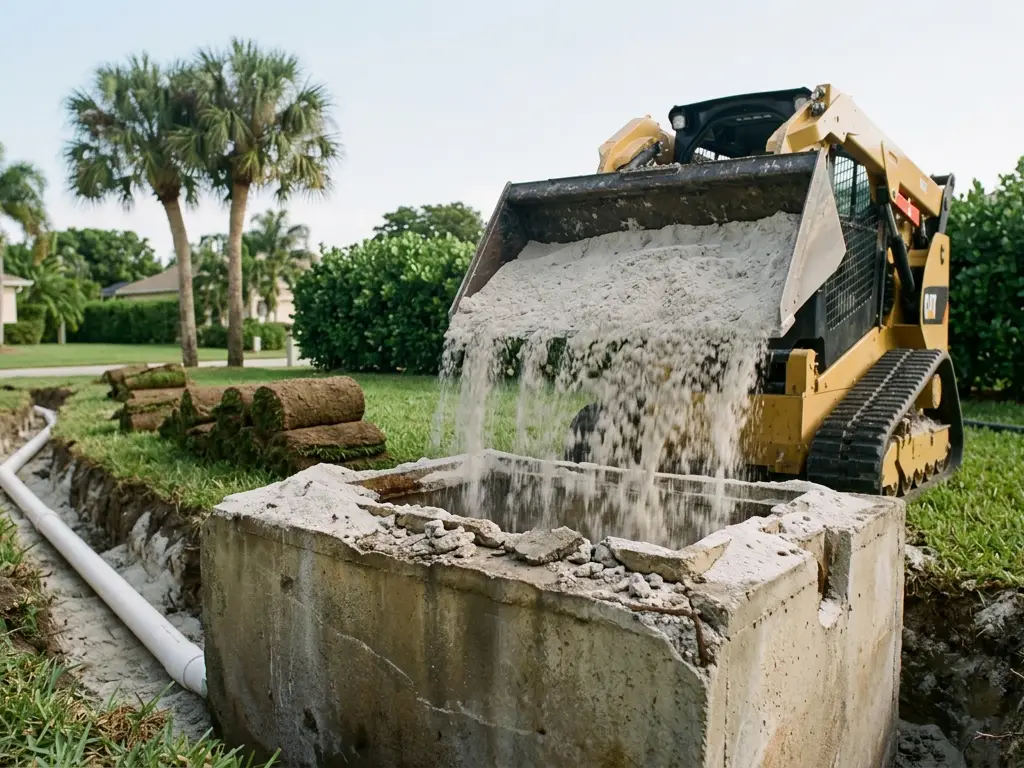
Once the house is connected, the old tank has to be taken out of service properly. Rule 62-6.011 requires abandonment within 90 days under permit: the tank pumped by a permitted hauler, broken open or collapsed, filled with clean sand and inspected. The septic half of a conversion typically runs $800 to $2,500. The septic to sewer conversion page walks through it step by step.
The larger costs usually sit on the utility side: connection or capacity charges, sometimes an assessment for the new main, and the private line from the house to the street. The Loxahatchee River District, for example, lists a connection charge, an on-site connection cost, an assessment and a quarterly service charge among the costs of joining its system. Ask your utility for its figures early.
Conversions around West Palm Beach
Several programs are working through the county. In Jupiter, the Loxahatchee River District has spent decades converting neighborhoods, and its list of future areas includes Jupiter Farms and Palm Beach Country Estates, with dates still to be set. Wellington's water supply plan describes bringing septic neighborhoods onto the village system when a majority of owners opt in and the Village Council approves. The Town of Lake Clarke Shores is converting its Northern Utility Service Area from septic to a town-owned sewer system now. And in Boynton Beach, annexation hearings have turned on exactly this question: what it costs a property owner to move from a tank to a sewer line.
Should you convert before you have to?
It depends on the state of your system and the cost of connecting. A septic system in good working order, pumped on schedule, can serve a house well for years. A system facing a major repair is a different matter: if sewer is already at the street, spending thousands on a new drainfield only to abandon it a year or two later rarely makes sense. That decision is worth making with the utility's connection costs in one hand and a proper evaluation of the septic system in the other.
Why the county keeps pushing sewer
A conventional drainfield removes only part of the nitrogen in household wastewater, roughly 30 to 40 percent where it sits at least 24 inches above groundwater. The rest can reach groundwater, and from there the lakes, rivers and the Lake Worth Lagoon. Around the Loxahatchee River, whose Northwest Fork became Florida's first National Wild and Scenic River in 1985, that is the whole reason the sewer district exists.
Questions about your own system? Talk it through on the phone.
Call (561) 658-4115Questions about septic vs sewer
How can I tell if my house is on septic or sewer?
Check your utility bill for a sewer charge, look for septic lids in the yard, and ask the Florida Department of Health in Palm Beach County whether a septic permit exists for the address. A cleanout pipe alone proves nothing.
Is septic or sewer cheaper?
Sewer has a steady monthly cost. Septic has no monthly bill but periodic costs: a pump-out every three to five years, typically $325 to $625, and occasional repairs. A neglected septic system can become far more expensive than sewer.
Do I have to connect to sewer in Florida?
Generally yes, once sewer is available and you receive written notice: within 365 days for a working system, or 90 days if the system needs repair, under Florida Statute 381.00655.
What happens to my septic tank when I connect to sewer?
It must be abandoned under permit within 90 days of connecting: pumped by a permitted hauler, broken open or collapsed, filled with clean sand and inspected.
Need the work done rather than explained?
Septic to Sewer Conversion in West Palm Beach and Jupiter, with a written price before anyone starts.
More septic guides
The Best Septic Companies in West Palm Beach
Local septic companies serving West Palm Beach, ranked by documented trading history, with no paid placements.
Septic Tank Pumping Costs in Palm Beach County
The typical price ranges for septic work around West Palm Beach, and the factors that push a quote up or down.
Palm Beach County Septic Tank Requirements
Who permits septic work in Palm Beach County, what the state rules require, and the deadlines that come with a sewer notice.
Signs You Need Septic Pumping in West Palm Beach
How to read what your septic system is telling you, from a slow drain to a pump alarm, before it becomes a backup.