
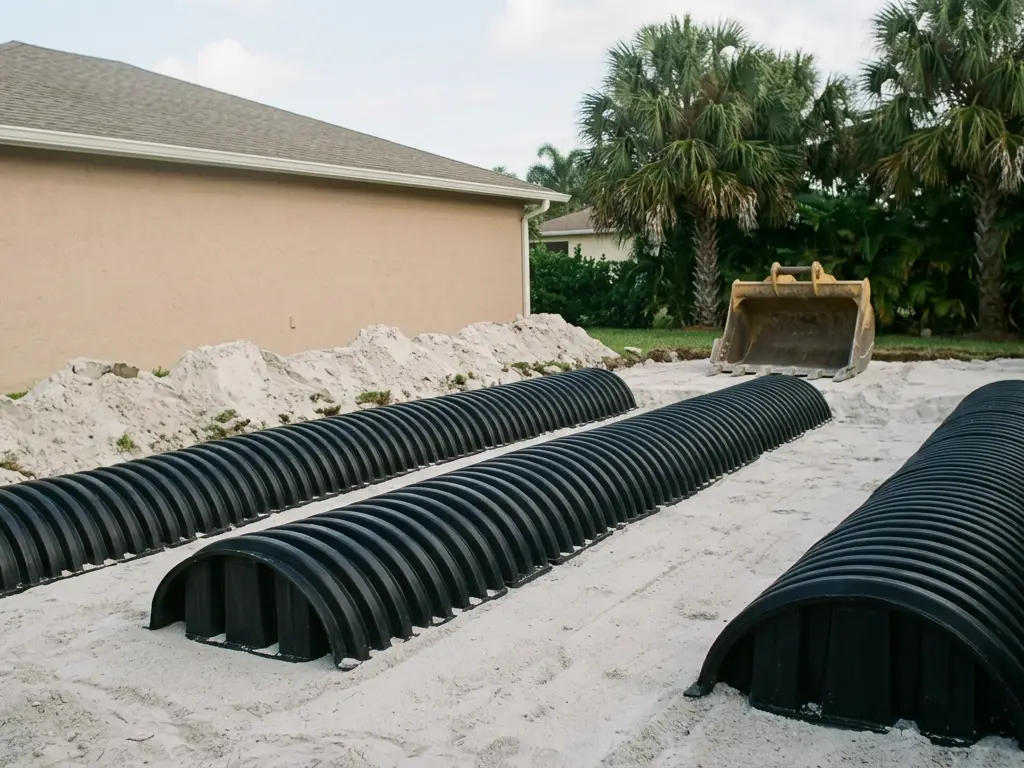
West Palm Beach Quality Septic: Septic System Installation in West Palm Beach, FL
New septic systems for new homes, rebuilds and additions, designed to the lot and permitted before a shovel goes in.
- Within 20 miles of downtown West Palm Beach
- Written price before work starts
- We work with licensed, insured local contractors
- Phones answered 7am to 7pm, seven days
West Palm Beach Quality Septic arranges new septic system installations for homes and small buildings within 20 miles of downtown West Palm Beach. Most new systems in this area go in where public sewer does not reach, which usually means the large lots to the west. A new system is a sequence rather than a single job: a site evaluation, a design sized to the house, a state construction permit, the installation, an inspection before anything is covered, and final approval before the building can be occupied.
Undersize a $9,000 to $18,000 new system to save money up front and the house can outgrow it, which is how owners end up paying $6,000 to $15,000 for a second field.
From site evaluation to final approval
The design starts with the ground: soil borings to identify the soil and to estimate the wet season high water table, and measurements to the well, the house, the property lines and any canal or pond. The house supplies the other half, because Florida sizes a system from bedrooms and floor area. Together they fix the size of the tank, the size of the drainfield and the elevation its bottom has to reach.
The system needs its own state construction permit, separate from the building permit for the house. Once issued, it is valid for 18 months and can be extended once by 90 days. The installation is inspected before it is covered, and the system has to receive final approval before the building can be occupied.
- Site evaluation: soils, water table, setbacks
- Design: tank size, drainfield size and elevation, pump if needed
- Construction permit, valid 18 months
- Installation, inspection before cover, final approval
Sizing the tank to the house
Florida's sizing table in rule 62-6.008 turns a house into an estimated daily flow and then into a minimum tank. A home of one to three bedrooms up to 2,250 square feet needs at least a 900 gallon tank; a four-bedroom home up to 3,300 square feet needs at least 1,050 gallons. The drainfield is sized from the same flow and the soil's ability to accept it. Where the bedroom count and the floor area point to different sizes, the larger one applies.
When a conventional system is not enough
On some lots a standard tank and field will not be approved. Where a lot of one acre or less sits inside a Florida basin management action plan area and sewer is not available, new systems must be enhanced nutrient-reducing units that remove a set share of nitrogen. Where setbacks or flows make a conventional design impossible, a Florida-licensed engineer can design a performance-based treatment system to a specific effluent standard. Both cost more than a conventional system, and the site evaluation is where you find out whether either applies.
Describe what the system is doing and get a straight read on what it usually means in West Palm Beach.
Call (561) 658-4115What a new septic system costs in West Palm Beach
The water table and the soil decide most of the price: an in-ground field on deep sand is the low end, a raised field with a pump is the high end. Typical local ranges:
New system, three bedroom, in-ground drainfield: $9,000 to $18,000
New system with a mound drainfield: $15,000 to $30,000
Lift pump replacement: $900 to $2,500
Typical ranges in the West Palm Beach area, not quotes. Call (561) 658-4115 and the price for your property is put in writing before anyone starts.
Installing a system under Palm Beach County conditions
Who issues the permit and inspects the work
The rules are Florida's Chapter 62-6, owned by the Department of Environmental Protection since July 1, 2021. In Palm Beach County the plan review, permitting and inspections are still carried out by the Florida Department of Health in Palm Beach County, whose Environmental Public Health office reviews plans for septic systems and private wells before building permits are issued.
Designing against the wet season
The field bottom must sit 24 inches above the wet season high water table, estimated from the soil's color and texture rather than from the water level on the day of the test. In the county's flatwoods soils that seasonal high can sit within six to eighteen inches of the surface for months, which is why so many new systems here use a raised field and a pump.
Where new systems go in
Florida's health department notes that growth in the western part of Palm Beach County keeps producing new homes that rely on private wells and septic tanks. The Acreage, where almost every home already has its own well and septic system, is the clearest example, and on those lots the 75-foot separation between the drainfield and the well shapes the whole site plan.
If you are buying land to build on
Get a site evaluation before you close on a lot, not after. The soil and the water table decide whether the system costs the low end of the range or the high end, and occasionally whether a conventional system can be permitted at all.
Septic System Installation: questions people ask
How much does a new septic system cost in West Palm Beach?
A new system for a three bedroom home with an in-ground drainfield typically runs $9,000 to $18,000. Where the water table requires a raised field, a new system with a mound typically runs $15,000 to $30,000. Engineered and nitrogen-reducing systems cost more.
How long does it take to get a septic permit in Palm Beach County?
It varies with the workload of the health department and the complexity of the site. Plan for the site evaluation, design and review to take weeks rather than days, and do not schedule the house build around an assumed permit date.
What size septic tank does my house need in Florida?
Under Florida rule 62-6.008, a home of one to three bedrooms up to 2,250 square feet needs at least a 900 gallon tank, and a four-bedroom home up to 3,300 square feet at least 1,050 gallons. Larger homes need larger tanks, and the larger of the bedroom and floor-area figures applies.
How far does a septic system have to be from a well in Florida?
For systems permitted under the current rule, at least 75 feet from a private drinking water well, and 75 feet laterally from surface water. Other setbacks apply to property lines, buildings and pipes.
Do I need a nitrogen-reducing septic system?
Only in specific places. New systems on lots of one acre or less inside a Florida basin management action plan area, where sewer is not available, must be enhanced nutrient-reducing systems. Whether a lot falls in one is checked during permit review.
Often needed alongside septic system installation
Mound Septic Systems
Raised drainfields for lots where the water table sits too close to the surface for a field in the ground.
Septic Tank Replacement
Cracked, collapsing or undersized septic tanks replaced under permit, sized to the house as it stands today.
Drainfield Replacement
A new drainfield designed around your lot, your water table and Florida's separation rule, permitted and inspected.
The Acreage and Loxahatchee
Well-and-septic country west of Royal Palm Beach, where nearly every home runs its own system.
Not sure which of these you need? Call (561) 658-4115 and describe what you are seeing. Every service and the full service area are listed too.