
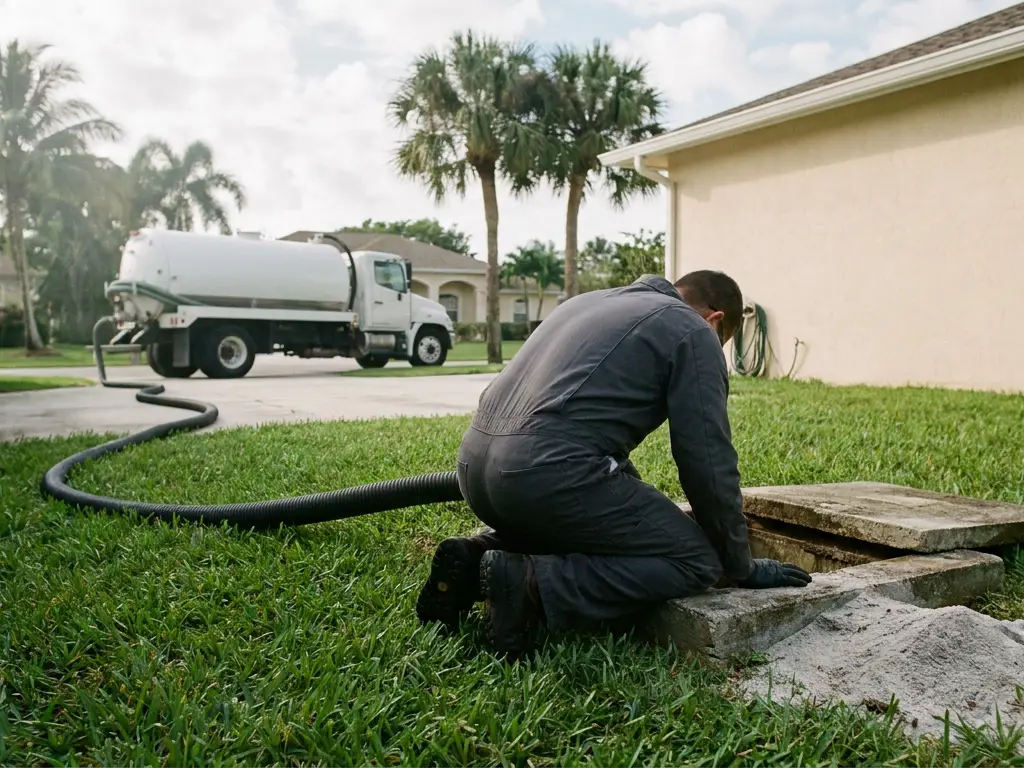
West Palm Beach Quality Septic: The Best Time to Pump a Septic Tank in South Florida
Why the dry months are the right time to pump a septic tank here, and how often it actually needs doing.
In most of the country, the best time to pump a septic tank is whenever it is due. In South Florida, the calendar matters more, because the ground a septic system depends on changes dramatically between the dry season and the wet one. Timing a pump-out to the weather makes it safer, easier and more informative.
Two seasons, two different septic systems
South Florida's year splits in two. The South Florida Water Management District counts roughly mid-May to mid-October as the wet season, and it brings about 70 percent of the year's rain. The rest of the year is the dry season.
The water table follows the rain. In the flatwoods soils across much of Palm Beach County, a cemented organic layer about a meter down holds water up, and during the wet season the water table can rise to within half a foot to a foot and a half of the surface for around four months. A drainfield that has plenty of dry soil beneath it in March may be sitting almost in groundwater by September.
Why the dry season is the better time to pump
It is safer for the tank. Florida health officials warn against pumping a tank while the water table is exceptionally high, because an empty tank in saturated ground can be crushed. An empty tank is also buoyant, and high groundwater pushes up on it. Pumping in the dry months, when the ground around the tank is not waterlogged, removes most of that risk.
The crew can see the system honestly. A drainfield that looks saturated in August might be fine; one that looks saturated in March probably is not. An inspection during a pump-out in the dry season gives a truer picture of how the field is really doing.
It is easier to get the work done. Digging to expose a buried lid in wet-season ground can mean digging into water. In the dry months the hole stays dry and the job is quicker.
It gets ahead of the storms. A tank pumped in the spring has time to settle back into normal operation before the wet season loads the whole system, and before hurricane season makes scheduling unpredictable.
A $325 to $625 pump-out booked for March is cheap insurance against a $1,500 to $6,500 drainfield repair diagnosed in the middle of a flooded September.
When not to wait
Timing is a preference, not a rule to follow while the house backs up. If sewage is coming up inside, the alarm on a pumped system will not clear, or effluent is surfacing in the yard, it needs attention whatever the month. The one exception is widespread flooding after a storm: then the health department's advice is to cut water use and wait for the water to drop before pumping.
How often to pump
Most households need a pump-out every three to five years. The Loxahatchee River District, which runs sewer for the Jupiter area, advises inspecting the tank every year to check the sludge depth and pumping every two to five years. What decides where you fall in that range:
- Tank size. Florida sets a 900 gallon minimum for homes of one to three bedrooms up to 2,250 square feet, and 1,050 gallons for four bedrooms up to 3,300 square feet. A tank at the minimum fills faster than a larger one.
- Household size. More people, more solids, sooner.
- A garbage disposal. It adds solids the tank has to hold.
- What goes down the drains. Grease, wipes and lint shorten the interval.
The only way to know for certain is to have the sludge and scum layers measured. A crew can tell you at each pump-out whether your interval should be shorter or longer.
A simple calendar for a South Florida septic system
- November to April: the window for scheduled pump-outs, inspections and any planned repairs. The ground is at its driest and crews can see the system clearly.
- May: last call before the rains. Pump now if you are due within the year.
- June to October: conserve water during long stretches of rain, keep sprinklers off the drainfield, and watch for the signs of a system losing its fight with groundwater.
- After any major storm: do not pump a flooded system. Use as little water as you can and have it checked once the water recedes.
If your system has a pump, check it before the rains
A raised drainfield depends on its pump, and the wet season is when that pump works hardest. A spring visit is the right moment to have the floats checked for tangles and grease, the alarm tested so you know what it sounds like, and the control panel looked at for corrosion. Know where the breaker for the pump circuit is, and make sure nothing has been planted or stacked over the pump chamber lid. A pump that fails in March is an inconvenience; one that fails during a week of August storms, with the water table already high, is a backup. Ten minutes of checking during the dry-season pump-out is the cheapest way to avoid it.
Where timing matters most
Timing matters most where the water table rises highest and the systems are most numerous. In The Acreage, almost every home has its own well and septic system, on flatwoods ground where the water table rises close to the surface every summer. For those homes, a dry season pump-out, with a check of the pump and floats where there is one, is the best annual habit there is. The septic tank pumping page covers what a pump-out includes and what it typically costs.
Keep a record
Write down the date of each pump-out, the tank size, and anything the crew noted about the baffles, the filter and the liquid level. After two or three services you will know your system's real interval, and you will have the record a buyer will ask for if you ever sell.
Questions about your own system? Talk it through on the phone.
Call (561) 658-4115Questions about best time to pump septic
When is the best time of year to pump a septic tank in Florida?
The dry season, roughly November through May in South Florida, when the water table is lower. Pumping a tank while the ground is waterlogged risks damaging it and gives a less accurate picture of the drainfield.
Can you pump a septic tank during the rainy season?
Yes, if it is needed, but not while the ground is flooded. Florida health officials warn that a tank pumped dry under an exceptionally high water table can be crushed.
How often should a septic tank be pumped in South Florida?
Every three to five years for most households. The Loxahatchee River District advises checking the sludge depth yearly and pumping every two to five years.
Should I pump my septic tank before hurricane season?
If it is due within the year, pumping in the spring is sensible: the tank settles back into normal operation before the wet season, and you avoid the scheduling crunch after a storm.
Need the work done rather than explained?
Septic Tank Pumping in West Palm Beach and The Acreage, with a written price before anyone starts.
More septic guides
The Best Septic Companies in West Palm Beach
Local septic companies serving West Palm Beach, ranked by documented trading history, with no paid placements.
Septic Tank Pumping Costs in Palm Beach County
The typical price ranges for septic work around West Palm Beach, and the factors that push a quote up or down.
Palm Beach County Septic Tank Requirements
Who permits septic work in Palm Beach County, what the state rules require, and the deadlines that come with a sewer notice.
Signs You Need Septic Pumping in West Palm Beach
How to read what your septic system is telling you, from a slow drain to a pump alarm, before it becomes a backup.